🎁 FREE EXPRESS SHIPPING ON ORDERS $300+
💎 COLLECT POINTS ON EACH PURCHASE
🎁REFER A FRIEND AND EARN CASH
🌍CANADA WIDE EXPRESS SHIPPING - TRACK NATIVE CARTONS 🎁SAVE MONEY ON NATIVE CARTONS









Smoking statistics in Canada reflect more than consumption patterns. They reveal how regulation, taxation, demographics, and public health campaigns shape behaviour across provinces and communities.
Canada monitors smoking prevalence through national surveys administered by Statistics Canada and Health Canada. These surveys measure adult smoking rates, youth usage patterns, and product trends across the country.
Health Canada publishes national tobacco surveillance data through the Canadian Tobacco and Nicotine Survey.
Statistics Canada reports smoking prevalence using the Canadian Community Health Survey.
Understanding these datasets helps explain how smoking rates have changed over time and how they differ by province, age group, and socioeconomic status.
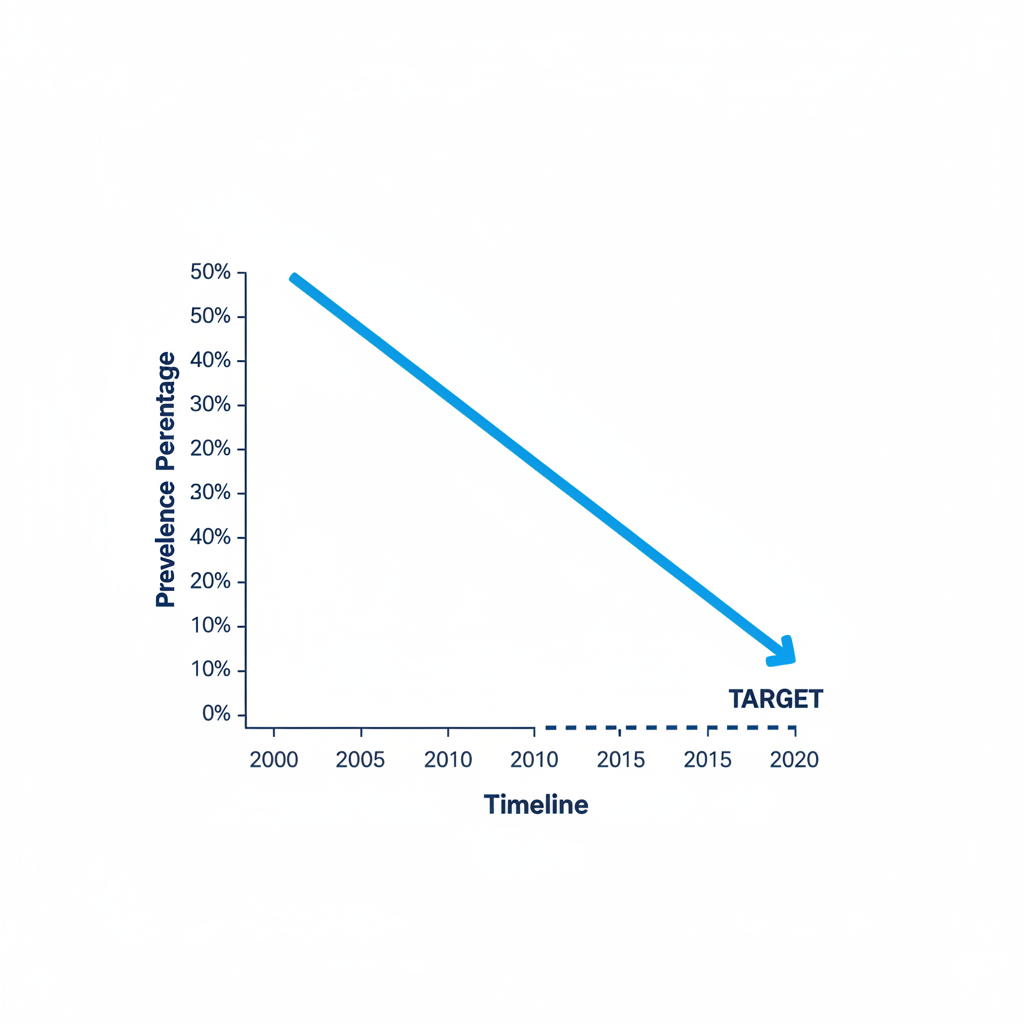
National smoking prevalence refers to the percentage of Canadians who report current cigarette use.
Health Canada data shows that adult smoking rates have declined significantly over the past two decades. In the early 2000s, adult smoking prevalence exceeded 20 percent. Recent national estimates place adult smoking closer to the low teens.
Official source: Health Canada – Canadian Tobacco and Nicotine Survey
National data distinguishes between daily smokers and occasional smokers.
Daily smokers consume cigarettes every day. Occasional smokers report smoking less frequently, often socially or intermittently.
Recent survey data shows that daily smoking has declined more sharply than occasional smoking. This indicates that heavy consumption patterns have reduced more significantly than casual experimentation.
Daily smoking → decreased → faster than occasional smoking
Youth smoking → declined → compared to early 2000s levels
Statistics Canada confirms that youth smoking rates today are significantly lower than rates reported in the early 2000s.
The timeline of smoking reduction in Canada can be divided into three phases.
2000 to 2010 saw gradual decline following stronger warning labels and advertising restrictions.
2010 to 2020 saw accelerated decline influenced by plain packaging rules, tax increases, and stronger youth access controls.
2020 to present shows continued reduction in cigarette smoking alongside increased use of alternative nicotine products such as vaping devices.
Health Canada regulates packaging and promotion under the Tobacco and Vaping Products Act.
Regulatory strength → correlates with → declining smoking rates
Taxation increases → associated with → reduced consumption
The federal government has set a target to reduce tobacco use to less than 5 percent by 2035. Official source: Health Canada
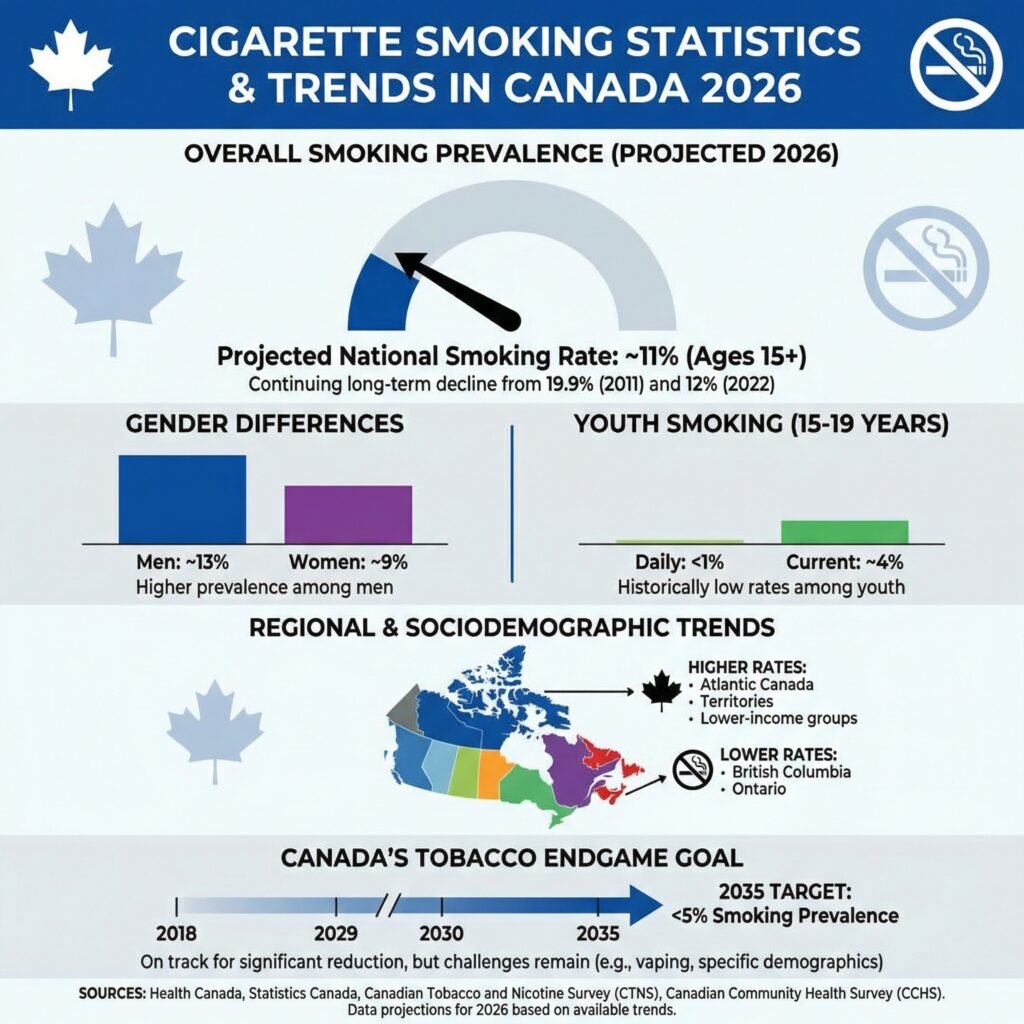
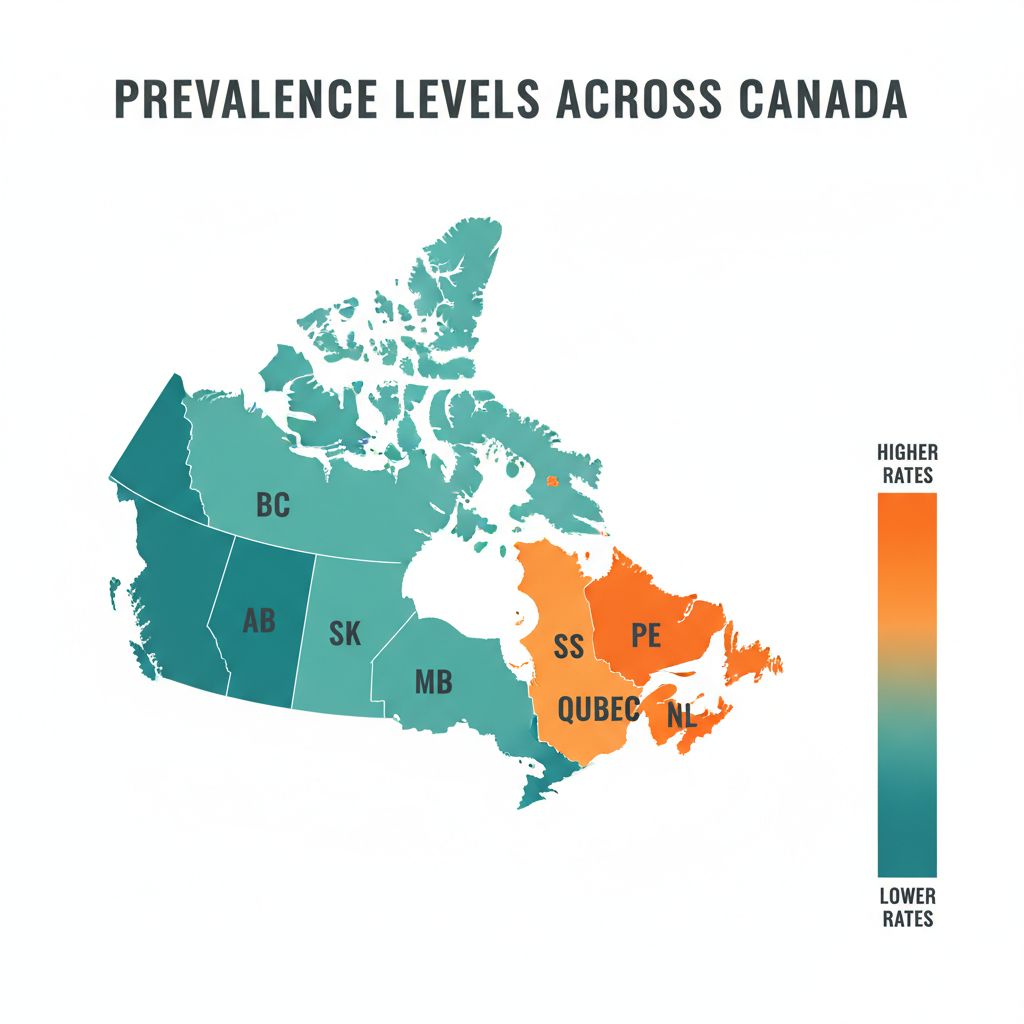
Smoking prevalence varies by province due to taxation levels, cultural factors, enforcement intensity, and demographic composition.
Ontario remains one of the most populous provinces and reports smoking rates close to the national average.
The Smoke-Free Ontario Act regulates retail display, advertising, and age restrictions. Official source:
Quebec historically reported slightly higher smoking prevalence compared to some western provinces.
Provincial tax policy and cultural consumption patterns influence regional variation.
Quebec tobacco control measures are governed by provincial public health law. Official source:
British Columbia consistently reports among the lowest smoking rates in Canada.
Strong public health enforcement and sustained awareness campaigns contribute to lower prevalence.
Official source: Government of British Columbia – Tobacco Control
Alberta reports smoking rates that align closely with national averages.
The province sets the legal age at 18 and regulates retail under provincial legislation.
Some Atlantic provinces and northern territories report higher smoking rates compared to national averages.
Geographic isolation, socioeconomic disparities, and cultural factors contribute to variation.
Statistics Canada publishes regional breakdowns within the Canadian Community Health Survey.
Smoking prevalence in Canada varies by age, gender, Indigenous identity, and socioeconomic status. These patterns show where tobacco use remains concentrated and where declines have been strongest.
Age influences smoking behaviour because initiation, experimentation, and long-term daily use tend to peak at different life stages. National surveys consistently show that current smoking is not evenly distributed across age brackets.
Health Canada reports that in 2022 the prevalence of current cigarette smoking among adults aged 25 and older was 11.7%, with a higher prevalence among men than women.
Statistics Canada publishes age-group tables for current smokers using national health survey estimates. These tables allow comparisons across age ranges and can be cited directly when you want to reference “smokers by age group” in Canada.
Youth smoking has declined sharply compared with the early 2000s, which is one of the most significant long-term shifts in Canadian tobacco use. Statistics Canada has published explanatory reporting on smoking indicators and prevalence trends, including national prevalence snapshots and age disaggregation. source: Statistics Canada, “Smoking, 2019” (methodology and prevalence reporting)
Gender differences remain consistent across most national datasets. Adult men report higher current smoking prevalence than adult women, although the gap has narrowed compared with past decades.
The CTNS 2022 national summary reports higher smoking prevalence among men than women for adults aged 25 and older.
Smoking prevalence is higher in many Indigenous populations compared with the national average, but trends differ across First Nations, Inuit, and Métis communities and also differ based on whether populations are on reserve or off reserve.
Statistics Canada provides a dedicated table for smoking status of First Nations people living off reserve, Métis, and Inuit, broken down by age group and gender. This is a primary citation source for Indigenous smoking statistics in Canada.
Health Canada’s tobacco strategy reporting also references First Nations Regional Health Survey findings for on-reserve First Nations, including estimates such as smoking prevalence in 2015 to 2016, while noting that updated RHS results are expected periodically.
The First Nations Information Governance Centre publishes the Regional Health Survey national report, which includes detailed smoking behaviour indicators and cessation-related measures among First Nations adults. source: FNIGC RHS Phase III report (PDF)
Socioeconomic status correlates with smoking prevalence in Canada. Lower income and lower educational attainment are commonly associated with higher smoking rates, while higher educational attainment correlates with lower smoking prevalence.
Statistics Canada and Health Canada survey tables provide breakdowns that can be used to support socioeconomic claims when you add the exact values you want to cite.
Smoking statistics become more useful when they distinguish between product categories. Traditional Cigarette use has declined over time and native cigarettes are gaining popularity in 2026, but nicotine use patterns are changing because more Canadians report alternative product use such as native cigarettes and vaping.
Manufactured cigarettes remain the most tracked tobacco product in national prevalence reporting because they have the largest historical burden of disease and the longest time series.
National prevalence estimates for cigarette smoking are reported through CTNS and through Statistics Canada health survey tables
Cigars and cigarillos are measured in national surveys but typically represent a smaller share of routine daily use compared with cigarettes. They are more likely to appear as occasional-use products depending on age group and social pattern.
The CTNS detailed tables include product use breakdowns that can be cited for cigar and cigarillo prevalence.
Vaping has become a major nicotine behaviour category in Canada. Even when cigarette smoking declines, overall nicotine exposure patterns can shift if vaping prevalence rises.
Health Canada tracks vaping and nicotine use through CTNS alongside cigarette smoking indicators.
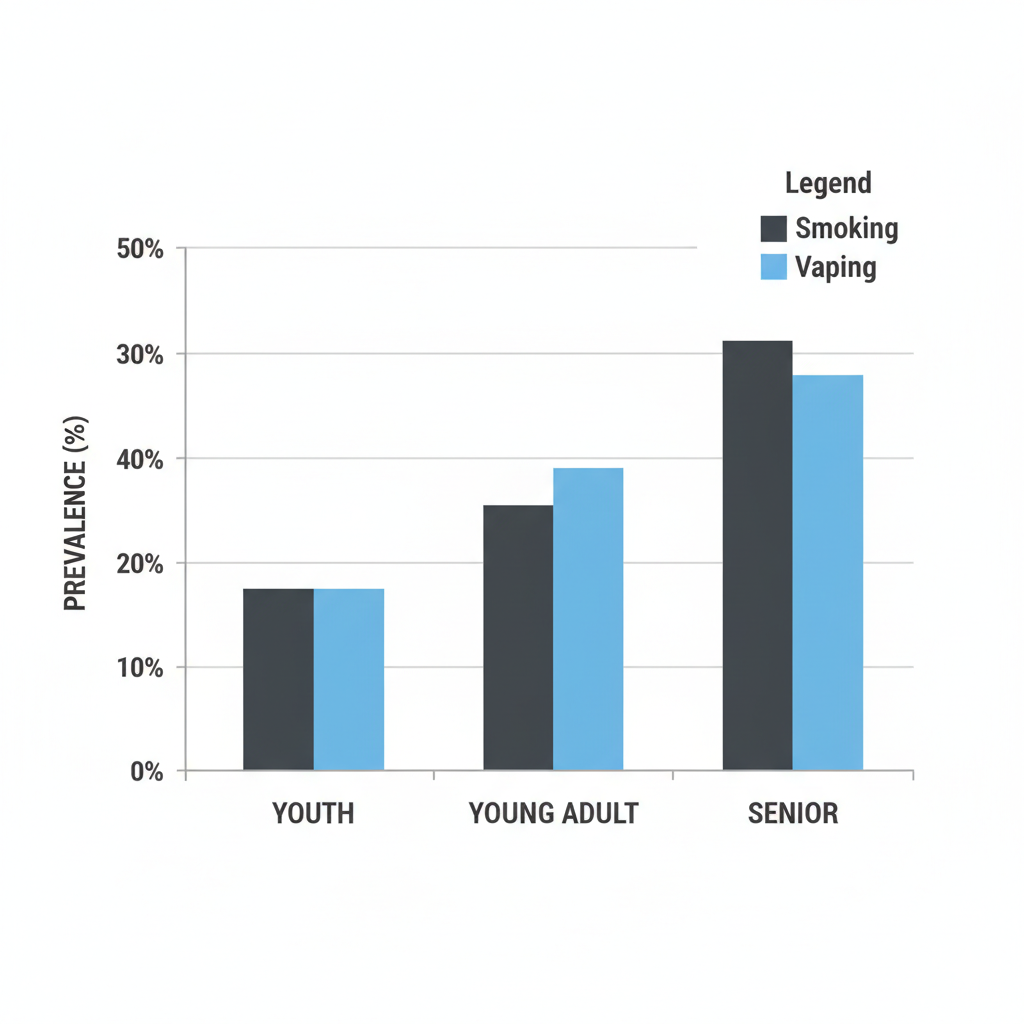
Roll-your-own tobacco and other tobacco products are included in national surveillance, but their prevalence tends to be more variable by region and demographic segment.
Product type usage varies by province because price, availability, and local consumption norms differ, even when national rules for packaging and advertising remain consistent under the Tobacco and Vaping Products Act.
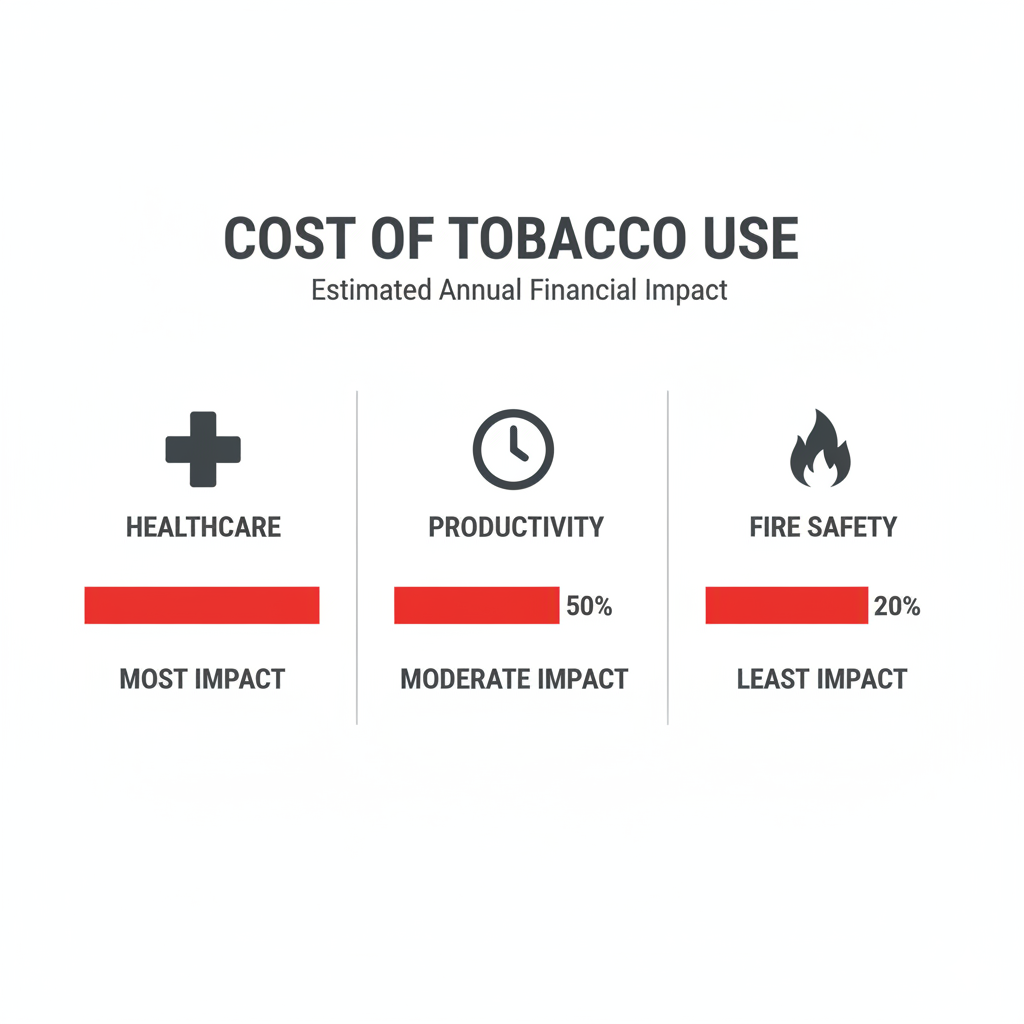
Smoking prevalence connects directly to health outcomes and national costs because combustible tobacco contributes to preventable disease, premature death, and long-term strain on healthcare systems.
Health Canada reports that tobacco use remains a significant preventable cause of disease and premature death in Canada, with approximately 46,000 deaths each year attributed to tobacco-related illnesses.
Health Canada also publishes mortality estimates that place annual tobacco-related deaths at about 48,000 based on 2017 data, which highlights that reported totals can vary depending on the dataset and year used.
These mortality figures are not abstract. Smoking contributes to lung cancer, cardiovascular disease, stroke, and chronic respiratory disease, which are the core drivers behind tobacco-attributable hospitalizations and long-term treatment needs. Health Canada describes tobacco as a leading preventable cause of premature death and disease burden nationally.
Economic burden is measured through direct healthcare costs and indirect costs such as productivity loss due to illness and premature death. Health Canada’s Tobacco Strategy overview states that total costs of tobacco use are more than 16 billion dollars per year.
A widely cited Canadian estimate of total tobacco costs appears in the Conference Board of Canada report “The Costs of Tobacco Use in Canada, 2012,” which estimates total costs of 16.2 billion dollars, with indirect costs representing the largest share. source: Conference Board of Canada, The Costs of Tobacco Use in Canada, 2012
Official PDF: Health Canada-hosted copy of the 2012 report
Public health research also models broader economic burden where smoking is included alongside other risk factors. The Public Health Agency of Canada published work noting the combined annual economic burden of excess weight, physical inactivity, and tobacco smoking at 52.8 billion dollars in 2013, which contextualizes smoking as a major contributor within preventable risk. Official source: Public Health Agency of Canada, HPCDP Journal article
This is why smoking statistics matter beyond prevalence. Smoking rate changes influence mortality projections, healthcare utilization, and national cost models used to justify taxation policy, prevention programs, and cessation support.
Health Canada provides cessation and support information for Canadians who want to quit smoking.
Smoking rates in Canada have declined over time, and policy is a major driver of that decline. Regulation influences smoking by limiting marketing, strengthening warnings, restricting youth access, and increasing friction in purchase behaviour.
Federal law governs the core framework for tobacco advertising and promotion, packaging and labelling requirements, and certain access restrictions. The Tobacco and Vaping Products Act is the primary federal statute that regulates tobacco and vaping product promotion and sets national rules for packaging and restrictions on youth access.
Canada’s national endgame target aims to reduce tobacco use to less than 5 percent by 2035. This goal is central to Canada’s Tobacco Strategy and is used as a national benchmark for progress.
This period saw stronger public awareness, broader smoke-free policies, and expansion of tobacco control measures across provinces. Smoking prevalence began a more sustained decline compared with the decades prior.
Statistics Canada reporting on smoking prevalence and indicators provides an accessible overview of prevalence and trend structure used for year-over-year monitoring.
This period included further tightening of marketing restrictions and policy efforts aimed at youth access. Youth smoking rates declined substantially compared with early 2000s levels, which is reflected in long-run survey comparisons.
Health Canada surveillance through the Canadian Tobacco and Nicotine Survey provides time series tracking for tobacco and nicotine behaviours in Canada
Cigarette smoking continues to decline, but nicotine behaviour becomes more complex because vaping and other product categories change the overall consumption landscape. CTNS tracks both smoking and vaping, which makes it the primary federal dataset for product mix analysis in recent years.
Policy influence also appears through the enforcement environment for access control. In Canada, remote and delivery-based sales require age verification at delivery, which strengthens compliance pressure for any legal online tobacco channel. The Tobacco and Vaping Products Act contains the remote sale requirement for age verification instructions at delivery.
The current adult smoking rate in Canada is in the low teens, according to recent data from Health Canada’s Canadian Tobacco and Nicotine Survey. Smoking prevalence has declined significantly compared with the early 2000s, when rates exceeded 20 percent.
Yes. Smoking rates in Canada have steadily declined over the past two decades. Federal tobacco control policies, graphic warning labels, advertising restrictions, tax increases, and smoke-free laws have contributed to this long-term reduction. Health Canada tracks these trends through national surveys.
Daily smoking has decreased more sharply than occasional smoking in Canada. National surveys distinguish between daily smokers and occasional smokers, with daily use showing sustained decline.
Smoking prevalence varies by province due to taxation levels, enforcement intensity, socioeconomic conditions, and cultural factors. Statistics Canada publishes provincial breakdowns in the Canadian Community Health Survey.
Rates change annually, so the most accurate comparison should reference the latest provincial dataset.
Smoking prevalence is higher in many Indigenous populations compared with the national average, although rates differ across First Nations, Métis, and Inuit communities. Data is reported by Statistics Canada and the First Nations Information Governance Centre.
Health Canada reports that tobacco use is associated with approximately 46,000 to 48,000 deaths per year in Canada, depending on the dataset year referenced. Smoking remains a leading preventable cause of premature death nationally.
The total economic cost of tobacco use in Canada exceeds 16 billion dollars annually when healthcare costs and productivity losses are combined.
No. Youth smoking rates have declined significantly compared with early 2000s levels. However, nicotine use patterns have evolved with the rise of vaping products. Health Canada monitors youth trends through national surveillance programs.
Canada’s federal tobacco strategy sets a national goal of reducing tobacco use to less than 5 percent by 2035. This target is part of Canada’s long-term public health strategy.
| # | Citation | Key Focus |
|---|---|---|
| 1 | Health Canada (2026). Delivering Results: Advancing Canada’s Tobacco Strategy. | Official report detailing the decline in tobacco use from 29% in 2001 to 13% in 2024, driven by federal and provincial policy interventions. |
| 2 | Statistics Canada (2025). Key findings from the Health of Canadians report, 2024. | Comprehensive data release consolidating smoking prevalence trends and regional variations across Canadian provinces and territories. |
| 3 | Ontario Tobacco Research Unit (2025). Canada’s Tobacco Endgame: A Critical Evaluation at the Midpoint. | Peer-reviewed evaluation of Canada’s progress toward the “less than 5% by 2035” target, including youth smoking and vaping prevalence. |
| 4 | Gravely, S., et al. (2022). Differences between adults who smoke cigarettes daily and occasionally. | Research study analyzing the sociodemographic and behavioral differences between daily and occasional smokers in the Canadian context. |
| 5 | Corsi, D. J., et al. (2014). Trends in smoking in Canada from 1950 to 2011: progression of the tobacco epidemic. | A longitudinal study tracking the geographic and socioeconomic distribution of daily and occasional smoking across Canada over six decades. |
| 6 | Lippert, A. M., & Corsi, D. J. (2025). The geographic distribution and community correlates of electronic cigarette use in Canada. | Recent research in the Canadian Journal of Public Health exploring sub-provincial variations in nicotine product use and their community drivers. |
| 7 | Health Canada (2025). Canadian Tobacco and Nicotine Survey (CTNS) 2024 Data Tool. | The primary federal surveillance tool providing the most recent available data on cigarette smoking and vaping use in Canada. |
No account yet?
Create an AccountYou must be 19 years of age or older to view page. Please verify your age to enter.
Your access is restricted because of your age.