

![Menthol vs Non-Menthol Native Cigarettes Canada [2026 Guide].](https://goldstarsmokes.ca/wp-content/uploads/2026/02/Menthol-vs-Non-Menthol-Native-Cigarettes-Canada-2026-Guide.png)
Blog
In 2026, cigarette prices in Canada vary widely due to provincial tax differences layered onto federal excise duty. Quebec, Ontario, and Alberta remain the most affordable provinces, while Atlantic provinces remain the most expensive. This guide by Gold Star Smokes breaks down how tobacco taxes work, provincial rates, price comparisons, and what smokers can expect in the future.
Cigarette Taxes in Canada: How They Vary by Province & What It Means for You
Cigarette prices in Ontario Canada are rising every year—but not evenly. If you’ve ever noticed that a pack costs far less in one province than another, you’re absolutely right. In 2026, every province sets its own tobacco tax rate, stacked on top of federal excise duty, creating some of the biggest price gaps Canadians have ever seen.
How Cigarette Taxes Work in Canada?
Cigarette pricing includes two layers of tax:
1. Federal Excise Duty (Applies Nationwide)
As of 2025, the federal government charges:
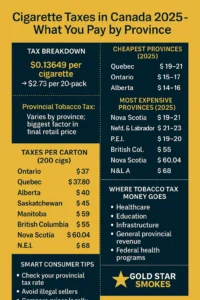
$0.13649 per cigarette
≈ $2.73 per 20-pack
This cost is built into the retail price before cigarettes ever reach stores.
Why this tax exists:
- To discourage smoking, especially among youth
- To fund Canadian healthcare, education, and tobacco-control initiatives
2. Provincial Tobacco Tax (Varies Widely)
Every province adds its own tax on top of the federal duty. This is why a Cigarette pack in Quebec might cost $14 while the same pack in Newfoundland costs $23.
General trends (2026):
- Lowest taxes: Ontario, Quebec, Alberta
- Mid-range taxes: Saskatchewan, Manitoba, B.C.
- Highest taxes: Atlantic provinces (Nova Scotia, N.L., P.E.I.)
These decisions reflect each province’s public-health goals, budget needs, and efforts to combat smuggling.
Cigarette Taxes by Province in 2026
| Province | Provincial Tax (Per Carton 200) | Avg. Pack Price |
| Ontario | $37.00 | $15–$17 |
| Quebec | $37.80 | $13–$15 |
| Alberta | $40.00 | $14–$16 |
| Saskatchewan | $45.00 | $16–$18 |
| Manitoba | $59.00 | $18–$20 |
| British Columbia | $55.00 | $18–$20 |
| Nova Scotia | $60.04 | $19–$21 |
| New Brunswick | $56.25 | $18–$19 |
| P.E.I. | $58.00 | $19–$20 |
| Newfoundland & Labrador | $68.00 | $21–$23 |
| Yukon / NWT / Nunavut | $55–$60 | $18–$21 |
Prices continue to climb annually as provinces adjust budgets and health policies.
Provincial Snapshots: What These Prices Mean For You?
Ontario – Reasonable & Balanced
Ontario’s moderate $37 tax keeps pack prices around $15–$17.
The province balances health goals with efforts to limit smuggling.
Quebec – Cheapest in Canada
With packs averaging $13–$15, Quebec is the most affordable province for smokers.
Strict packaging and marketing restrictions offset its lower tax rate.
Alberta – Low Tax + No PST
Alberta’s $40 per-carton tax and zero provincial sales tax keep prices at $14–$16.
It’s considered one of the best-value provinces.
British Columbia – Health-Driven Strategy
With taxes around $55 per carton, B.C. prices rise to $18–$20+.
Funds support healthcare and anti-smoking campaigns.
Atlantic Provinces – Most Expensive
Nova Scotia, P.E.I., and Newfoundland & Labrador consistently have the highest prices.
Newfoundland leads with packs often over $21–$23.
Why Provincial Tax Rates Vary?
Tobacco tax isn’t random. Provinces set their own rates based on:
- Healthcare spending needs
- Smuggling pressures (border provinces often keep taxes moderate)
- Demographics (regions with low smoking rates may raise tax to maintain revenue)
- Political priorities (annual budget commitments)
A tax policy may aim to reduce smoking rates, increase public revenue, or balance both.
Where Tobacco Tax Money Actually Goes?
Most consumers assume all tobacco taxes fund smoking programs—but only a small portion does.
Your cigarette tax dollars support:
Provincial Revenue
- Hospitals & medical care
- Schools & public education
- Infrastructure
- Community and social programs
Federal Programs
- National healthcare
- Anti-smoking campaigns
- Public education initiatives
How Taxes Affect the Economy & Consumer Behaviour?
Economic Effects
- Higher prices reduce consumption (especially in youth and new smokers)
- Heavy smokers often switch to cheaper products (RYO tobacco, value brands, pouches)
- Small retailers can lose revenue due to thin margins
- Licensed online retailers for Native Cigarettes online in Canada like Gold Star Smokes offer transparent legal pricing
Behavioural Effects
- Comparing prices by province
- Buying cartons instead of packs
- Switching to lower-cost brands
- Exploring alternatives like vaping or nicotine pouches
Do Higher Taxes Actually Reduce Smoking?
Yes—research consistently shows that increasing cigarette taxes lowers smoking rates, particularly among youth.
But taxes work best when combined with:
- Public-health education
- Plain packaging
- Cessation support
- Strong enforcement against illegal tobacco
Quick Snapshot: Cheapest vs. Most Expensive Provinces (2026)
| Province | Avg. Pack Price | Category |
| Quebec | $13–$15 | Cheapest |
| Ontario | $15–$17 | Affordable |
| Alberta | $14–$16 | Affordable |
| Saskatchewan | $16–$18 | Mid-range |
| Manitoba | $18–$20 | Mid-range |
| B.C. | $18–$20 | Mid-range |
| Nova Scotia | $19–$21 | Expensive |
| Newfoundland & Labrador | $21–$23 | Most Expensive |
Difference between cheapest and most expensive: over $7 per pack
→ That’s $210+ per month for a pack-a-day smoker.
Staying Updated on Future Tax Changes
Cigarette taxes typically increase during:
- Federal budget announcements (April)
- Provincial budget releases (Spring/Fall)
To stay informed:
- Follow Government of Canada excise updates
- Review provincial finance ministry announcements
- Subscribe to legal retailers like Gold Star Smokes for pricing updates
What This Means for You: Key Takeaways
- Taxes are the largest cost in a pack of cigarettes.
- Quebec, Ontario & Alberta remain the most affordable provinces.
- Atlantic provinces remain the most expensive.
- Prices will continue rising due to health and economic priorities.
- Buying legally from licensed retailers like Gold Star Smokes ensures compliance and transparency.
Helpful Consumer Tips
✔ Check provincial tax rates before traveling or moving
✔ Avoid illegal or untaxed sellers—they’re unsafe & unlawful
✔ Consider cessation resources if exploring smoke-free alternatives
✔ Buy from licensed Canadian retailers like Gold Star Smokes for verified pricing
FAQ for Cigarettes Taxes In Canada
Q1: Why do cigarette taxes vary between provinces?
Each province sets tax rates based on healthcare needs, budget demands, smuggling risks, and public-health strategy.
Q2: Does Ottawa control cigarette prices?
No. The federal government sets excise duty, but final prices depend on provincial tax and retail markup.
Q3: Will cigarette prices rise after 2025?
Almost certainly. Most provinces adjust tobacco taxes annually or bi-annually.
Q4: Can cigarettes be bought legally online in Canada?
Yes—only through licensed Canadian retailers such as Gold Star Smokes.
Q5: How is tobacco tax revenue used?
Most of it funds healthcare, education, infrastructure, and general provincial budgets.
Final Thoughts
Cigarette taxes in Canada represent more than just the cost of a pack—they reflect public-health goals, economic strategy, and provincial priorities. Whether you live in Quebec or Newfoundland, understanding how these taxes work helps you:
- Make smart, legal, cost-conscious decisions
- Understand where your money goes
- Stay informed about future tax changes
At Gold Star Smokes, our mission is to provide clear, accurate, legal information about tobacco pricing and regulation so adult Canadians can make informed, responsible choices.
References
- Canada Revenue Agency (CRA). Excise Duty Rates (2025).
https://www.canada.ca/en/revenue-agency/services/forms-publications/publications/edrates/excise-duty-rates.html - Government of Canada. EDN101 Tobacco Excise Duty Adjustments (2025).
https://www.canada.ca/en/revenue-agency/services/tax/technical-information/excise-duty/excise-duty-notices/edn101-adjusted-rates-excise-duty-tobacco-products-effective-april-1-2025.html - Health Canada – Tobacco Control Directorate (2025).
https://www.canada.ca/en/health-canada/services/health-concerns/tobacco/meeting-summaries-tobacco-vaping-industry.html