



![Menthol vs Non-Menthol Native Cigarettes Canada [2026 Guide].](https://goldstarsmokes.ca/wp-content/uploads/2026/02/Menthol-vs-Non-Menthol-Native-Cigarettes-Canada-2026-Guide.png)
Blog
Native cigarettes in Canada are more than an affordable smoking option. They are connected to Indigenous sovereignty, treaty rights, cultural practice, and economic survival.
To understand Native-produced tobacco today, you need to separate three connected but distinct realities:
- Traditional sacred tobacco
- Commercial Indigenous tobacco enterprises
- Federal and provincial regulatory frameworks
Each plays a role in shaping the modern Native cigarette market.
Contents
hide
The Origins of Native Cigarettes
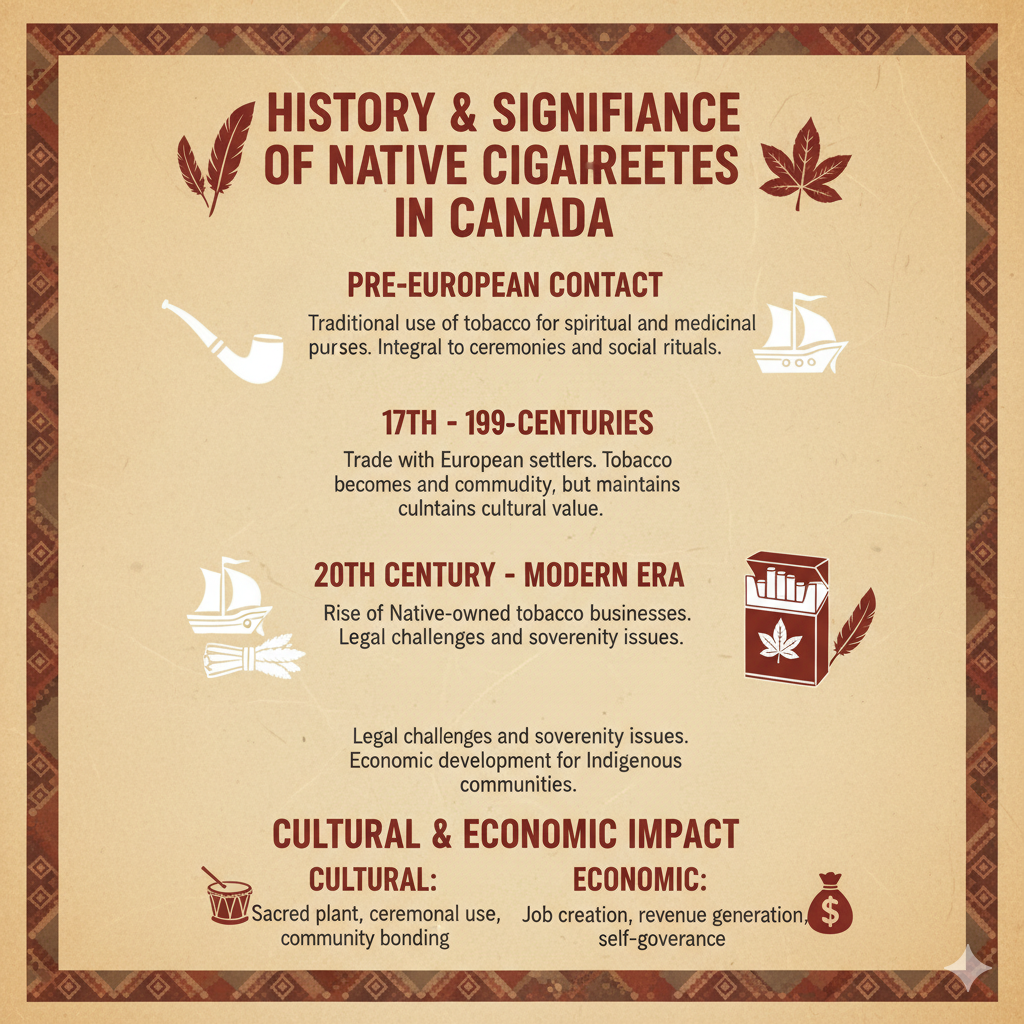
For centuries, tobacco has held a sacred role in many First Nations cultures across North America. Traditionally, tobacco was used in ceremonies, prayers, and as a symbol of respect and offering. With time, Indigenous communities began producing commercial tobacco products as a way to create self-sustaining businesses.
By the late 20th century, Native cigarette brands became widely recognized for their affordability, largely due to tax exemptions on reserve lands. This gave Indigenous entrepreneurs the chance to build industries that competed directly with mainstream tobacco corporations.
Sacred Tobacco in First Nations Traditions
Long before European contact, tobacco held spiritual and ceremonial importance across many First Nations communities.
- Tobacco → used in → prayer, ceremony, and offerings
- Tobacco → symbolizes → respect, gratitude, and connection
In many traditions, tobacco was not inhaled casually. It was offered to the earth, burned during ceremony, or presented when asking for guidance. The plant itself was considered sacred medicine.
This traditional use differs fundamentally from commercial cigarette production. However, it establishes tobacco as an Indigenous crop with deep cultural roots.
Colonial Impact and the Rise of Commercial Tobacco
Following colonization, Indigenous communities faced land displacement, economic restriction, and limited access to mainstream industries.
During the 20th century, particularly in the 1970s and 1980s, some First Nations communities began producing and distributing commercial tobacco products as a means of economic self-determination.
Key drivers included:
- Limited employment opportunities on reserves
- Assertion of treaty and inherent rights
- Access to traditional agricultural knowledge
- Growing demand for lower-cost cigarettes
By the late 20th century, Indigenous cigarette brands became widely known across Canada.
Taxation, Treaty Rights, and Economic Sovereignty
A central issue in the Native cigarette market is taxation.
Reserve lands → fall under → federal jurisdiction
Provincial taxes → often not applied → on-reserve transactions involving status individuals
This framework led to price differences between reserve-sold cigarettes and mainstream retail outlets.
For many Indigenous communities, tobacco manufacturing became:
- A primary employer
- A source of infrastructure funding
- A tool for economic independence
Tobacco enterprises on reserves often support:
- Housing projects
- Education programs
- Community health services
- Local governance operations
This is not simply a pricing advantage. It represents economic sovereignty in action.
Legal and Compliance Context
Native cigarettes are legal when purchased from authorized Indigenous retailers. However, they remain regulated under Canada’s Tobacco and Vaping Products Act (TVPA), requiring Proof-of-Age delivery for online sales.
Products sold on reserves may be exempt from certain provincial tobacco taxes, but they still need to comply with shipping and packaging laws.
- Online tobacco sales → regulated by → Tobacco and Vaping Products Act
- Shipment of tobacco → requires → Proof-of-Age verification
- Packaging → must include → federally mandated health warnings
Products sold on reserves may be exempt from certain provincial taxes, but they must still comply with federal manufacturing, labeling, and age restrictions.
Legal age varies by province:
- 18 in Alberta
- 19 in Ontario, British Columbia, and most other provinces
For online retailers, adult signature verification at delivery is mandatory.
1. Tobacco and Vaping Products Act (TVPA)
The TVPA is administered by the Department of Justice Canada and sets national standards for:
• Advertising restrictions
• Packaging and labelling
• Age access limitations
• Retail compliance
Section 9 of the Act requires retailers who sell tobacco remotely to instruct the delivery service to verify the age of the recipient at the time of delivery.
- Official source:
Department of Justice Canada – Tobacco and Vaping Products Act
https://laws-lois.justice.gc.ca/eng/acts/T-11.5/
2. Health Canada – Tobacco (Access) Regulations
Health Canada enforces access restrictions and retailer obligations under the Tobacco (Access) Regulations.
These regulations prohibit the sale of tobacco products to minors and outline compliance obligations for sellers.
- Official source:
Health Canada – Tobacco (Access) Regulations
https://www.canada.ca/en/health-canada/services/smoking-tobacco/tobacco-legislation/regulations.html
Health Canada also mandates graphic health warning labels and standardized packaging requirements.
3. Canada Post – Proof of Age Delivery
When tobacco is shipped within Canada, carriers must verify the age of the recipient at delivery.
Canada Post’s Proof of Age service requires:
• Government-issued photo identification
• Signature confirmation
• Refusal of delivery if age cannot be verified
- Official source:
Canada Post – Proof of Age Service
https://www.canadapost-postescanada.ca/cpc/en/support/articles/proof-of-age-delivery.page
This requirement applies to online tobacco purchases, including those shipped from Indigenous retailers.
Provincial Minimum Age Requirements
Minimum legal age varies by province:
- Ontario → minimum age → 19
- British Columbia → minimum age → 19
- Alberta → minimum age → 18
Ontario source:
https://www.ontario.ca/page/smoke-free-ontario-act
British Columbia source:
https://www2.gov.bc.ca/gov/content/health/keeping-bc-healthy-safe/tobacco-control
Alberta source:
https://www.alberta.ca/minimum-legal-age.aspx
Retailers must ensure compliance with the legal age of the destination province when shipping tobacco products.
Community-Based Ownership vs Corporate Tobacco
One of the most overlooked aspects of Native cigarettes is ownership structure.
- Major multinational tobacco corporations → distribute profits → to shareholders globally
- Many Indigenous tobacco operations → circulate profits → within local communities
Community-owned models keep economic activity localized.
That said, the landscape varies. Some operations are fully community-controlled. Others are privately run by Indigenous entrepreneurs. The structure differs by territory and band governance.
Why It Matters for Canadian Smokers
Choosing Native cigarettes doesn’t just mean saving money. It also means:
-
Supporting Indigenous-owned businesses.
-
Respecting the cultural roots of tobacco in Canada.
-
Ensuring purchases are compliant and authentic (with proper excise markings or trusted reserve sources).
Public Health Considerations
It is important to distinguish cultural history from modern health realities.
- Commercial cigarettes → associated with → serious health risks
- Health Canada → regulates → warning labels and advertising
Indigenous communities are not exempt from the public health impacts of smoking. Many also run smoking cessation programs within their own territories.
- Health Canada – Smoking and Tobacco
https://www.canada.ca/en/health-canada/services/smoking-tobacco.html
Acknowledging health impacts does not negate economic realities. It creates a dual conversation around livelihood and wellness.
Why This History Matters Today
When Canadian smokers purchase Native cigarettes, they participate in a market shaped by:
Treaty interpretation
Federal regulation
Economic resilience
Cultural continuity
For some buyers, affordability is the main factor.
For others, supporting Indigenous-owned enterprises carries social and economic meaning.
Understanding the broader historical context adds clarity beyond simple price comparison.
Common Misconceptions
-
Native cigarettes are “illegal.”
They are legal when purchased from authorized online tobacco retailers in Canada like Gold Star Smokes that comply with federal regulations. -
All Native cigarettes are tax-free.
Tax application depends on jurisdiction and purchaser status. -
Traditional tobacco equals commercial cigarettes.
Sacred tobacco use is culturally distinct from modern commercial production.
Addressing these misconceptions strengthens consumer awareness.
The Ongoing Evolution of Indigenous Tobacco Enterprises
The Native cigarette industry continues to evolve.
Some communities are exploring:
- Diversified manufacturing
- Cross-border distribution agreements
- Alternative nicotine products
- Formalized regulatory frameworks with provinces
The relationship between Indigenous sovereignty and Canadian law remains dynamic.
Conclusion
The history of Native cigarettes is rooted in tradition, resilience, and economic empowerment. For Indigenous communities, they represent more than a product—they are a livelihood and a continuation of cultural identity. For Canadian smokers, buying Native cigarettes online is not only a financial choice but also a way to contribute to the growth and sustainability of Indigenous economies.