🎁 FREE EXPRESS SHIPPING 5550+ Orders Shipped Canada Wide 💎 COLLECT POINTS ON EACH PURCHASESame-day dispatch before 4 PM ET 🎁REFER A FRIEND AND EARN CASH ⭐⭐⭐⭐⭐ 5 star rated 🎁SAVE MONEY ON CARTONS








When shopping for native cigarettes in Canada, one of the most common questions buyers have is whether to choose menthol or non-menthol (regular) varieties.
Menthol and non-menthol cigarettes differ primarily in their flavouring and sensory effects. Menthol produces a cooling sensation that can make tobacco smoke feel less irritating, while non-menthol cigarettes lack that added cooling effect.
However, this distinction has important health and legal implications in Canada.
In October 2017, Canada implemented a federal prohibition on menthol additives in cigarettes marketed domestically. The restriction applies to cigarette products regardless of whether they are manufactured by Indigenous or non-Indigenous businesses.
Menthol can reduce the perceived harshness of smoke without reducing exposure to the harmful chemicals associated with combustible tobacco. Research also associates menthol cigarettes with increased nicotine dependence and greater difficulty quitting.
This guide explains the differences between menthol and non-menthol cigarettes, how menthol affects sensory perception and nicotine dependence, and Canada’s rules governing menthol tobacco products.
Before choosing, it’s important to understand that menthol affects sensation, not necessarily nicotine strength — a common misconception among buyers.
Menthol cigarettes are combustible tobacco products containing menthol, a compound that occurs naturally in peppermint and can also be manufactured synthetically.
Menthol activates cold-sensitive receptors in the mouth and respiratory tract. This creates a cooling sensation and can reduce the perceived irritation associated with inhaling cigarette smoke.
The compound does not remove harmful substances from tobacco smoke. The cooling effect can instead make smoke feel less harsh than it otherwise would.
Menthol affects the sensory perception of smoke through its cooling and mild numbing properties.
Studies have also associated menthol cigarette use with greater difficulty quitting smoking.
Canada prohibited menthol additives in cigarettes sold domestically through federal regulations implemented in October 2017.
The prohibition covers menthol, l-menthol and l-menthone in tobacco products covered by the applicable legislation.
Manufacture on a First Nations reserve does not create an automatic exemption from the federal menthol restriction.
Sources:
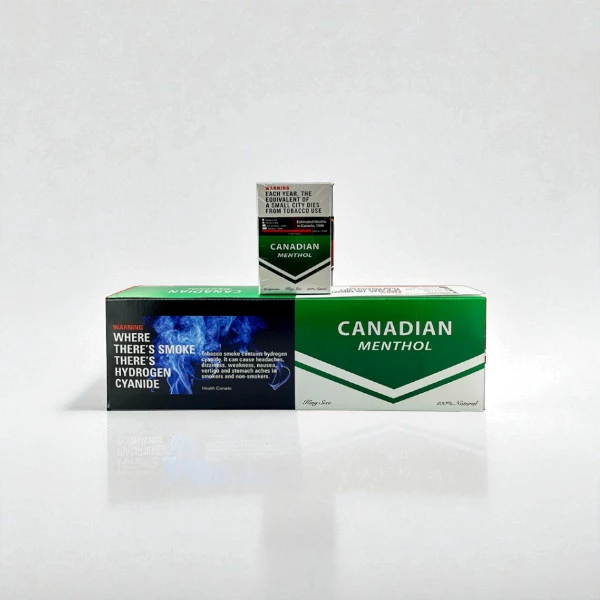

Most menthol native cigarettes available in Canada are categorized into:
Light Menthol
Medium Menthol
Full / Strong Menthol
This means buyers can still choose based on nicotine tolerance, just as they would with non-menthol options.
Menthol is often selected for its sensory appeal rather than strength differences.
Non-menthol cigarettes are combustible tobacco products that do not contain menthol as an added flavouring ingredient.
Their smoke does not produce the characteristic menthol-induced cooling sensation. However, the composition and sensory properties of cigarette smoke can still vary according to tobacco blends and manufacturing characteristics.
Both menthol and non-menthol cigarettes produce harmful chemicals when tobacco burns.
Non-menthol cigarettes are associated with substantial health risks, including lung cancer, cardiovascular disease, chronic obstructive pulmonary disease (COPD) and nicotine addiction.
Removing menthol does not make smoking safe. Menthol’s additional effects on smoking behaviour and nicotine dependence are important when comparing the two product categories.
The distinction between menthol and non-menthol products concerns flavouring, sensory perception and some addiction-related effects. Both remain harmful combustible tobacco products.
Many smokers describe non-menthol cigarettes as having a stronger throat hit, especially in medium and full strength categories.
Like menthol products, regular native cigarettes are typically available in:
Light
Medium
Full / Strong
This allows buyers to choose based on nicotine tolerance and smoking habits rather than flavor alone.
Regular native cigarettes remain the most widely preferred option among traditional tobacco users across Canada.
Menthol changes the perceived sensation of cigarette smoke, but the presence or absence of menthol does not determine whether a cigarette is safe.
| Feature | Menthol cigarettes | Non-menthol cigarettes |
|---|---|---|
| Menthol additive | Contains menthol | No added menthol |
| Cooling sensation | Characteristic cooling effect | No menthol-induced cooling effect |
| Perceived irritation | Menthol can mask irritation | Lacks menthol’s masking effect |
| Nicotine exposure | Depends on product and smoking behaviour | Depends on product and smoking behaviour |
| Addiction | Menthol may increase dependence and make quitting harder | Nicotine remains addictive |
| Health risks | Harmful combustible tobacco | Harmful combustible tobacco |
| Canadian legal status | Menthol additives prohibited in domestic cigarettes since 2017 | Subject to ordinary Canadian tobacco laws |
Menthol can make smoke feel less irritating by activating receptors associated with cooling sensations.
This sensory effect should not be confused with reduced toxicity. Menthol does not eliminate carbon monoxide, carcinogens or other harmful substances produced by tobacco combustion.
Source: CDC: Menthol Tobacco Products Are a Public Health Problem
Menthol can make cigarette smoke feel less harsh, but this sensory effect does not reliably indicate lower nicotine exposure.
The cooling sensation comes from menthol’s interaction with receptors involved in detecting cold and irritation.
Terms such as light, medium and full strength are not reliable measurements of how much nicotine a person absorbs while smoking.
Nicotine exposure depends on multiple factors, including cigarette design, nicotine content and individual smoking behaviour.
A cigarette described as light should not be assumed to carry a lower health risk.
Yes. Research reviewed by the CDC: Menthol Tobacco Products indicates that menthol may enhance nicotine’s addictive effects and make quitting smoking more difficult.
The cooling sensation associated with menthol can also mask some of the irritation produced by inhaling tobacco smoke.
Across Canada, non-menthol native cigarettes generally maintain higher overall demand due to traditional smoking habits. However, menthol products remain popular among users who prioritize smoothness and flavor.
Availability may vary by province due to regulatory factors, so buyers should always verify product listings and shipping eligibility within their region.
Some buyers assume switching to menthol means switching to a lighter cigarette. This is not always the case.
When choosing between menthol and non-menthol, it’s better to:
First select your preferred strength (light, medium, or full)
Then choose whether you prefer cooling or traditional tobacco flavor
Choosing between menthol and non-menthol native cigarettes ultimately comes down to personal preference, smoking history, and strength tolerance.
Below is a simple decision framework to help buyers in Canada select the right option.
Before deciding on menthol or regular, determine your preferred strength level:
Once strength is selected, flavor becomes the secondary decision.
A cooling sensation on inhale
A smoother perceived throat feel
Mint-forward flavor
A less harsh sensation
Traditional tobacco taste
A more direct throat hit
No added cooling or mint flavor
A classic smoking experience
If you are switching from another product:
Matching your previous flavor type and strength usually results in a smoother transition.
Availability can vary slightly depending on:
Provincial regulations
Shipping policies
Inventory differences
Buyers in Ontario, Quebec, British Columbia, and Alberta should confirm product availability before ordering online.
| Your Preference | Recommended Option |
|---|---|
| Want smooth & cool | Menthol |
| Prefer bold tobacco | Non-Menthol |
| Sensitive to harshness | Menthol Light |
| Want strong throat hit | Full Regular |
| New to native brands | Light (Menthol or Regular) |
Choosing the right option is about aligning strength level + flavor preference with your smoking habits.
The presence of menthol does not establish the nicotine content of a cigarette.
Nicotine content and nicotine delivery are influenced by tobacco composition, product design and smoking behaviour.
Terms such as light and full strength should not be interpreted as precise scientific measurements of nicotine exposure.
Menthol is also associated with changes in nicotine dependence. The CDC reports that menthol may enhance nicotine’s addictive effects, making it more difficult for some people to quit.
Consumers should avoid interpreting flavour, cooling sensation or manufacturer strength descriptions as indicators of reduced exposure to tobacco-related health risks.
Strength (light, medium, full) is usually just a variation within the same product line — not a premium upgrade.
Menthol and non-menthol options are often priced similarly within the same brand and carton size. However, slight differences may occur due to:
Inventory demand
Availability
Supply sourcing
Promotional offers
These variations are typically small and not driven by nicotine level.
Not necessarily.
A full-strength carton generally costs the same as a light or medium carton within the same brand category. The nicotine intensity does not automatically increase manufacturing cost in a way that significantly impacts retail pricing.
Buyers in provinces like Ontario, Quebec, British Columbia, and Alberta may notice differences primarily due to shipping and regional market conditions rather than strength.
Menthol cigarettes contain an additive that produces a cooling sensation and can reduce perceived smoke irritation. Non-menthol cigarettes do not contain that added menthol flavouring.
Federal law prohibits menthol additives in cigarettes marketed domestically. Canada’s restriction took effect in October 2017 and does not provide an automatic exemption for Indigenous-manufactured cigarettes.
The federal government restricted menthol because its cooling and flavouring effects can increase tobacco’s appeal, particularly among younger people, and contribute to smoking initiation.
No. Menthol cigarettes expose smokers to harmful substances produced by tobacco combustion. The cooling effect does not make cigarette smoke safer.
Menthol does not establish how much nicotine a particular cigarette contains. However, research indicates that menthol can enhance nicotine dependence and make quitting more difficult.
Menthol activates cold-sensitive receptors and reduces the perception of smoke irritation. That does not mean the smoke contains fewer harmful chemicals.
No. Light or mild descriptions do not reliably represent actual nicotine exposure or reduced health risks.
Federal menthol restrictions also apply to cigarettes manufactured or sold on First Nations reserves. Indigenous ownership or manufacturing location does not, by itself, exempt a product from those requirements.
No account yet?
Create an AccountYou must be 19 years of age or older to view page. Please verify your age to enter.
Your access is restricted because of your age.