🎁 FREE EXPRESS SHIPPING 5550+ Orders Shipped Canada Wide 💎 COLLECT POINTS ON EACH PURCHASESame-day dispatch before 4 PM ET 🎁REFER A FRIEND AND EARN CASH ⭐⭐⭐⭐⭐ 5 star rated 🎁SAVE MONEY ON CARTONS







Last updated: November 13, 2026
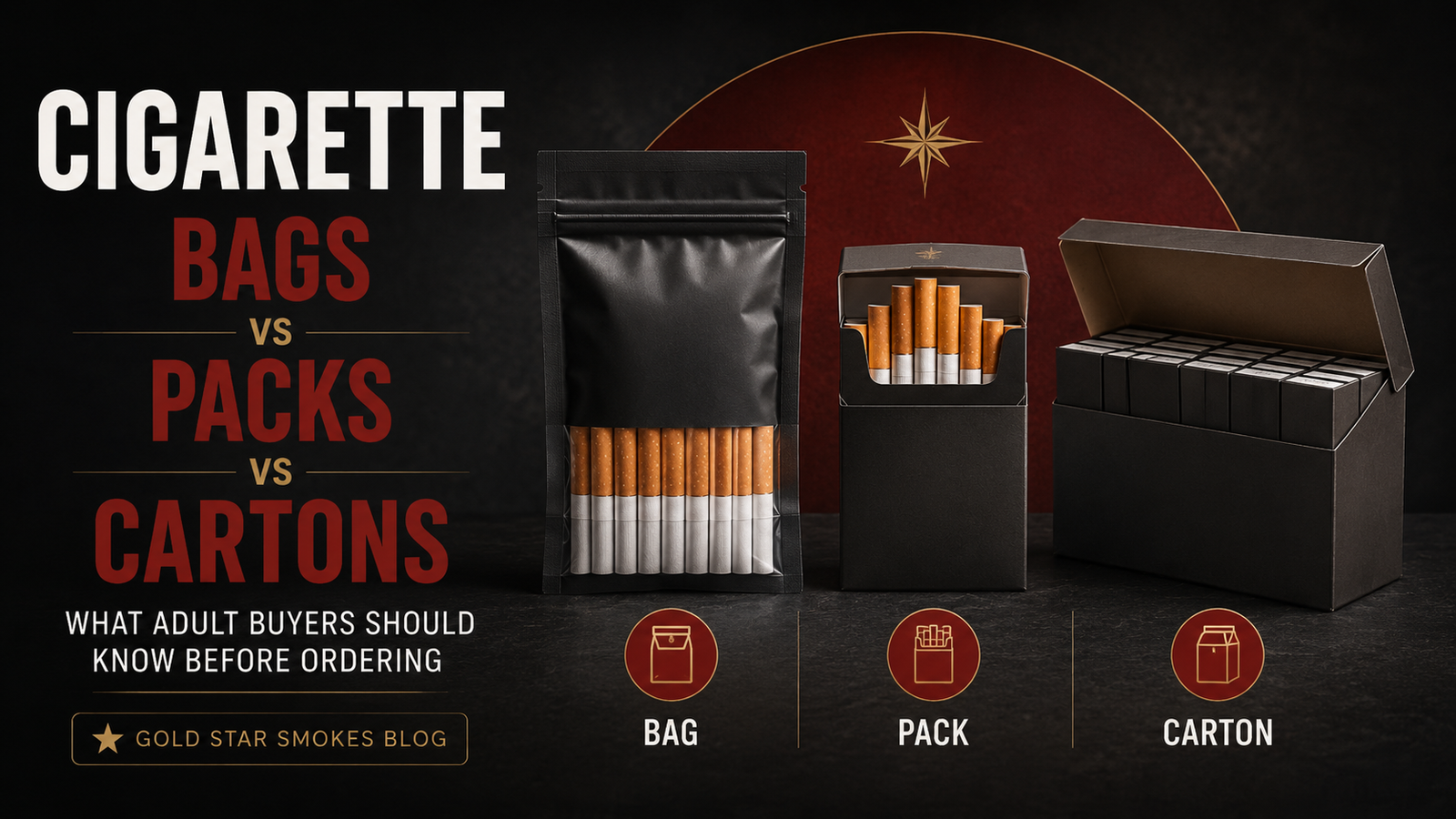
Cigarette bags, packs, and cartons differ primarily in how cigarettes are packaged, how many cigarettes they contain, and how the individual units are organized.
A standard cigarette pack in Canada commonly contains 20 or 25 cigarettes. A conventional carton often contains 200 cigarettes, arranged as ten packs of 20 or eight packs of 25. A cigarette bag may also contain 200 cigarettes, but the products are grouped in bulk packaging rather than separate conventional packs.
The differences extend beyond packaging. Canada’s tobacco regulations establish requirements for minimum cigarette quantities, standardized packaging, health warnings, excise stamps, and tobacco sales.
This guide compares the three formats using cigarette counts, unit-price calculations, federal excise duty, storage considerations, and Canadian regulatory requirements.
The simplest way to compare cigarette packaging is to examine the total cigarette count and the number of individual packages.
| Feature | Cigarette pack | Cigarette carton | Cigarette bag |
|---|---|---|---|
| Typical cigarette count | 20 or 25 | Often 200 | Varies; 200-count examples exist |
| Packaging structure | Individual package | Multiple cigarette packs | Bulk bag-style package |
| Individual packs inside | Not applicable | Usually yes | Usually no |
| Common 200-count configuration | 10 packs of 20 | 10 × 20 or 8 × 25 | One 200-count bag |
| Primary distinction | Small retail unit | Multi-pack grouping | Bulk packaging |
| Federal tobacco requirements | Apply | Apply to constituent packages and relevant outer packaging | Apply according to the product and packaging classification |
| Tobacco health warnings | Required | Applicable labelling requirements | Applicable labelling requirements |
A carton and a bag can contain the same number of cigarettes. Their principal difference is the way those cigarettes are packaged.
The difference between a cigarette bag, pack, and carton is not simply the number of cigarettes.
A pack is an individual package. A carton contains multiple packs. A cigarette bag groups cigarettes in bulk packaging.
These distinctions affect how quantities are described, how products are handled, and which packaging characteristics are relevant.
Federal excise duty and provincial cigarette taxes are generally linked to the quantity and classification of tobacco, rather than whether a retailer describes the package as a bag or carton.
Canada also imposes mandatory tobacco packaging, health-warning, and sale requirements. The October 2026 packaging deadline reinforces the importance of distinguishing commercial packaging terminology from legal compliance.
For accurate comparisons, identify the cigarette count, packaging structure, price basis, applicable taxes, and relevant regulatory requirements.

A cigarette pack is an individual package containing a specified quantity of manufactured cigarettes.
In Canada, packs commonly contain 20 or 25 cigarettes. Section 10 of the federal Tobacco and Vaping Products Act prohibits the sale, packaging, distribution, or importation for sale of cigarettes in packages containing fewer than 20 cigarettes, unless a higher minimum is prescribed.
You can see that format explained in the Canadian Goose Cigarettes Guide BB cigarettes guide and the Playfare Cigarettes Guide.
A pack is useful when you want:
For example, a buyer comparing BB Full and BB Light may prefer to test the closer match before committing to a larger quantity.
Choose packs if:
A pack is not usually the best value format, but it can be the smartest testing format.
A 25-cigarette pack contains five more cigarettes than a 20-cigarette pack, representing 25% more cigarettes.
| Pack size | Cigarette count | Quantity relative to a 20-pack |
|---|---|---|
| Standard 20-pack | 20 | 100% |
| Standard 25-pack | 25 | 125% |
The difference affects package quantity and excise duty, but it does not establish that either format has a lower retail price per cigarette.

A cigarette carton is an outer package containing multiple cigarette packs.
One of the most common configurations is ten packs of 20 cigarettes, producing a total of 200 cigarettes.
Another configuration consists of eight packs of 25 cigarettes, also producing 200 cigarettes.
Some products use a ten-pack configuration with 25 cigarettes in each pack, resulting in 250 cigarettes.
Choose cartons if:
Cartons work well for buyers who order brands such as Canadian Goose, Playfare, BB, DK, and Discount after they already know which strength suits them.
| Carton configuration | Calculation | Total cigarettes |
|---|---|---|
| 10 packs of 20 | 10 × 20 | 200 |
| 8 packs of 25 | 8 × 25 | 200 |
| 10 packs of 25 | 10 × 25 | 250 |
The term “carton” therefore does not always identify a single cigarette quantity.
For accurate comparisons, both the pack count and the number of cigarettes per pack should be stated.
A carton containing 250 cigarettes has 25% more cigarettes than a 200-cigarette carton.
For more information about carton quantities and taxation, see our Canadian cigarette carton guide.

A cigarette bag is a packaging format in which manufactured cigarettes are grouped inside a bulk bag rather than arranged in multiple conventional retail packs.
Some commercially advertised cigarette bags contain 200 cigarettes. These products can therefore have the same total cigarette count as a conventional 200-cigarette carton.
However, the name “cigarette bag” is a commercial packaging description, not a separate federal excise-duty category.
Choose cigarette bags if:
Bags can be a strong fit for price-first buyers, but storage habits matter more.
No. They may contain the same number of cigarettes, but their packaging structures are different.
A carton typically contains multiple individual packages. A 200-count bag groups cigarettes into a single bulk-style package.
For example:
The total quantity is identical in this example.
The packaging format does not, by itself, determine the tobacco tax rate, legal status, product quality, or retail price.
Choose packs if you want the smallest quantity or you are testing a brand for the first time.
Choose cartons if you already know the brand you like and want better value per pack.
Choose 200-count cigarette bags if you want bulk value, prefer a resealable format, and are comfortable storing one larger supply carefully.
Here is the simple version:
| Format | Best For | Common Count | Main Advantage | Main Caution |
|---|---|---|---|---|
| Pack | First-time brand testing | 20 cigarettes | Lowest commitment | Higher cost per cigarette |
| Carton | Repeat buyers | 10 packs / 200 cigarettes | Better value and sealed packs | Requires more upfront spend |
| Bag | Bulk-value buyers | Often 200 cigarettes | Low-cost bulk format | Must reseal and store carefully |
For most buyers, the best first step is to choose the brand first using the Native Cigarette Brand Selector, then choose the format.
A meaningful price comparison uses the same measurement for every package: cost per cigarette.
The calculation is:
Unit price = total package price ÷ number of cigarettes
Consider the following illustrative examples.
| Packaging format | Illustrative price | Quantity | Calculated cost per cigarette |
|---|---|---|---|
| Pack | $18 | 20 | $0.90 |
| Carton | $180 | 200 | $0.90 |
| Bag | $180 | 200 | $0.90 |
| Carton | $225 | 250 | $0.90 |
These are mathematical illustrations, not observed retail prices or offers.
Every product in this example has the same unit price despite differences in package size and total price.
Cigarette storage depends on the packaging materials, closure, exposure to air, humidity, temperature, and handling.
The distinction between packs, cartons, and bags is primarily the number of separate packages exposed when the outer packaging is opened.
A standard cigarette pack contains a smaller quantity than a carton or bulk bag.
Once opened, its contents can be exposed to air and environmental conditions.
The packaging materials and closure affect how much protection remains after opening.
A carton generally contains multiple individual cigarette packs.
Opening its outer packaging does not necessarily open every constituent pack.
As a result, the remaining individually packaged products may experience less direct handling and exposure than cigarettes grouped together in one open container.
However, a carton does not guarantee freshness or provide an established universal storage lifetime.
Bag-style packaging may have a resealable closure, depending on the product.
The effectiveness of the closure depends on the bag materials, seal construction, and actual storage conditions.
A resealable bag should not automatically be described as airtight or freshness-preserving without supporting manufacturer evidence.
| Factor | Pack | Carton | Bag |
|---|---|---|---|
| Separate individual packages | One | Multiple | Generally one bulk package |
| Exposure after opening | Individual pack contents | Depends on which packs are opened | Bulk contents may be exposed |
| Closure design | Pack-dependent | Individual packs | Bag-dependent |
| Guaranteed freshness period | None established universally | None established universally | None established universally |
Tobacco products should be kept away from children, pets, ignition sources, excessive moisture, and heat.
Packaging differences do not make smoking safer.
For further discussion of storage conditions, see our cigarette carton storage guide.
Canada regulates tobacco packaging through the Tobacco and Vaping Products Act and the Tobacco Products Appearance, Packaging and Labelling Regulations.
These rules are not limited to conventional cigarette packs.
Manufacturers and retailers must comply with the applicable requirements for the product and packaging involved.
Section 10 of the Tobacco and Vaping Products Act generally requires cigarette packages to contain at least 20 cigarettes, unless a higher minimum applies under the regulations.
The minimum quantity requirement is one part of the legal framework, not a complete compliance test.
Canada requires standardized tobacco packaging appearance, with prescribed restrictions on colours, presentation, and other characteristics.
These requirements help prevent packaging from being used to promote tobacco products through distinctive visual designs.
Tobacco packaging is subject to mandatory health-warning and information requirements.
Health Canada’s regulations include health warnings, toxicity information, cessation messaging, and health-related messages printed directly on cigarettes.
Health Canada established October 31, 2026, as the retailer implementation deadline for cigarette packages displaying updated health-information messages on extended upper slide-flaps.
The corresponding manufacturer deadline was July 31, 2026.
This is a significant current requirement for assessing cigarette-packaging compliance in Canada.
The detailed applicability of each requirement depends on the product and package design.
Source: Health Canada, Tobacco Products Appearance, Packaging and Labelling Regulations.
Packs are best when you do not know the brand yet.
If you are deciding between Canadian Goose Red and Blue, Playfare Original, Light, and Menthol, or BB Full and BB Light, a smaller format can reduce the risk of choosing the wrong strength.
Use packs when:
Once you know the brand works for you, a carton or bag may make more sense.
Cartons are best for buyers who already know their preference.
A carton gives you multiple sealed packs, which helps with routine and storage. You can open one pack at a time while keeping the rest closed. That makes cartons easier to manage than one large opened supply.
Cartons are a good fit if you already know:
For example, if you already know Canadian Goose works for you, buying a carton is usually more practical than buying single packs repeatedly.
If you want full brand-level help first, start with the Native Cigarette Brand Selector.
Cigarette bags are best for buyers who care most about bulk value and are comfortable with resealable storage.
Gold Star’s Discount Full Flavour Cigarette Bags and Discount Light Cigarette Bags are both 200-count bag options, making them directly comparable with many 200-cigarette carton formats by total count.
Bags can make sense if you:
The main tradeoff is storage discipline.
With cartons, unopened packs remain separate.
With bags, more of the product relies on one resealable closure.
That makes proper storage more important.
The format does not change delivery responsibility.
Whether you order a pack, carton, or bag, tobacco orders in Canada must be handled as adult-only shipments.
Canada Post states that Proof of Age is required for tobacco product shipments, with limited exceptions for certain shipments between manufacturers, retailers, or two consumers. Canada Post’s tobacco and vaping products page explains this shipping requirement.
Canada Post also explains that when Proof of Age applies, the delivery agent visually verifies the recipient and may request photo ID and a signature if the recipient appears under 30. Canada Post’s Proof-of-Age page outlines the recipient verification process.
That means buyers should:
The federal Tobacco and Vaping Products Act says no person shall send or deliver a tobacco product or vaping product to a young person. Section 9 also describes verification using government-issued identification containing the person’s name, photograph, date of birth, and signature. Justice Laws, Tobacco and Vaping Products Act, section 9 provides the federal language.
This is why Gold Star’s content should consistently connect format-buying articles to compliance pages such as:
Use this simple decision path.
| Buyer Type | Best Format | Why |
|---|---|---|
| First-time Native cigarette buyer | Pack | Lowest commitment while testing |
| Regular brand buyer | Carton | Better value and easier routine |
| Price-first buyer | Bag | 200-count bulk value |
| Storage-conscious buyer | Carton | Individual packs help preserve freshness |
| Light-smoke buyer | Pack or carton | Test first, then buy carton |
| Full-flavour repeat buyer | Carton or bag | Depends on brand and storage preference |
| Menthol buyer | Pack or carton | Depends on product availability |
| Rural buyer | Carton | Fewer repeat orders can reduce delivery friction |
For rural and remote delivery, Goldstarsmokes provides you with an option to Buy Native Cigarettes Online in Rural Canada also – Find your province here.
Look at final checkout cost, not just product price.
A 20-cigarette pack and 200-count bag are not the same buying decision.
If you are unsure about strength, test first.
Bags need careful resealing after use.
Proof-of-Age rules apply regardless of format.
Bulk value only works when the product can be stored properly.
Cigarette packs are best for testing.
Cigarette cartons are best for repeat buying.
Cigarette bags are best for bulk-value buyers who can reseal and store them properly.
If you are new to a brand, start small. If you already know your brand, compare carton pricing. If cost per cigarette is your main concern, compare 200-count bag options such as Discount Full Flavour Cigarette Bags and Discount Light Cigarette Bags.
The smartest choice is not always the cheapest format.
It is the format that fits your brand preference, storage habits, delivery expectations, and final order value.
The main difference is packaging structure. A pack contains an individual quantity, commonly 20 or 25 cigarettes. A carton contains multiple packs, while a cigarette bag groups cigarettes in bulk-style packaging.
A conventional cigarette carton commonly contains 200 cigarettes. Examples include ten packs of 20 or eight packs of 25. Some cartons contain 250 cigarettes.
The quantity depends on the product. Some commercially advertised cigarette bags contain 200 cigarettes, but the term “bag” does not establish a standardized national count.
Not necessarily. Two packages containing 200 cigarettes can have different retail prices. The unit cost must be calculated from their actual selling prices.
The bag format does not automatically reduce tobacco excise duty. Under Canada’s standard federal cigarette rate, duty is determined using cigarette quantities and statutory package units.
No. A bag of manufactured cigarettes is not necessarily the same product as loose tobacco used for rolling cigarettes. The distinction matters because tobacco taxes and regulations can classify these products differently.
A 200-cigarette quantity does not automatically establish legal compliance. Packaging, health warnings, excise requirements, and sales conditions must also meet applicable laws.
A carton usually contains multiple individual cigarette packs. Its contents may be the same packaged products available as individual packs. The outer carton is primarily a packaging and distribution unit.
Cartons often separate cigarettes into individual packages, while bulk bags may expose a larger quantity when opened. However, freshness depends on packaging materials, seals, and storage conditions. No format guarantees freshness.
Federal and provincial tobacco laws apply regardless of packaging format. Commercial interprovincial delivery to consumers is generally prohibited by federal law, subject to specified exceptions.
No account yet?
Create an AccountYou must be 19 years of age or older to view page. Please verify your age to enter.
Your access is restricted because of your age.